
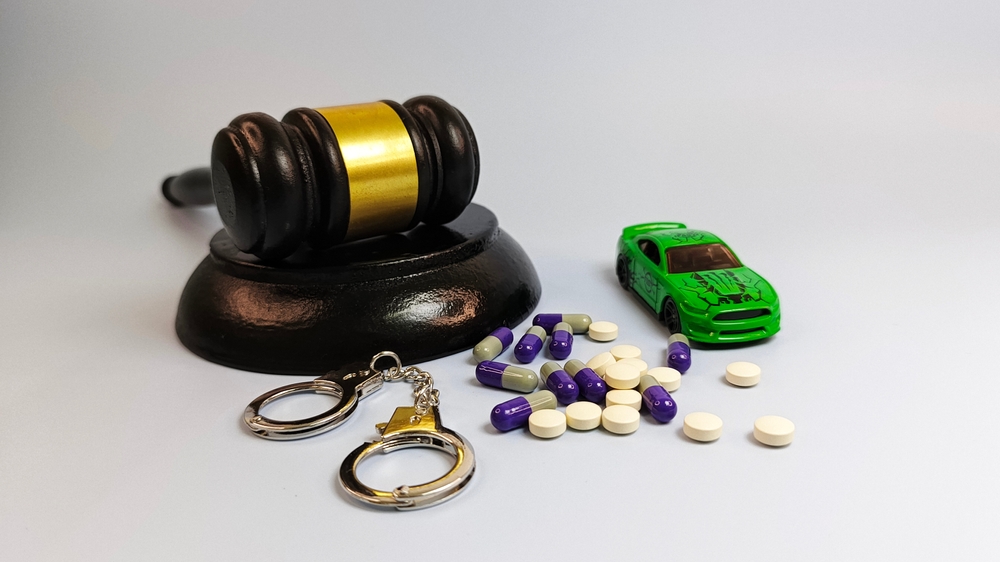
Most people think of DUI as an alcohol problem. Someone has too many drinks at happy hour, gets behind the wheel, and ends up facing serious consequences. But there’s a different kind of DUI that’s been quietly rising across California, and it’s catching a lot of drivers completely off guard.
We’re talking about drug DUIs, specifically those involving prescription medications and marijuana. These aren’t people using illegal street drugs or trying to get high before driving. Many of them are everyday Californians taking medications prescribed by their doctors, or legally using cannabis, who genuinely didn’t realize they could be arrested for DUI.
The numbers tell the story. In 2018, 42% of all drivers killed in motor vehicle crashes in California who were tested came back positive for legal or illegal drugs. By recent estimates, that percentage has only increased. In fact, over 50% of drivers killed in crashes who were tested for drugs in California now test positive. That’s more than half, and drugs are now implicated in 20 to 25% of all roadway fatalities in the state annually, nearly matching alcohol-related deaths.
If you’re taking prescription pain medication, anti-anxiety meds, or if you’re a legal marijuana user, this is information you need to know.
Why Drug DUIs Are on the Rise in California
A few major factors are driving the increase in drug-related DUI arrests across California.
First, marijuana legalization. California’s Proposition 64 made recreational marijuana legal for adults 21 and over back in 2016. Today, about one in four Californians report using marijuana in the past year, and usage is especially high among young adults, with over 40% reporting use. While legalization removed criminal penalties for possession and use, it didn’t change the fact that driving while impaired by marijuana is still very much illegal.
Second, prescription medication use is widespread. Painkillers, anti-anxiety medications, sleep aids, antidepressants, and stimulants are commonly prescribed and widely used. Many people take these medications daily and assume that because a doctor prescribed them, they’re safe to drive on. That’s not always the case. Medications like benzodiazepines (Xanax, Valium), opioids (codeine, hydrocodone), and even some allergy medicines can significantly impair your ability to drive safely.
Third, law enforcement has gotten better at detecting drug impairment. Police officers now receive specialized training as Drug Recognition Experts (DREs), and they’re using more sophisticated testing methods to identify drivers under the influence of drugs. While there’s still no roadside breathalyzer equivalent for drugs, blood tests and field sobriety evaluations are becoming standard practice in suspected drug DUI cases.
The Law in California: It Doesn’t Matter If It’s Legal
Here’s what catches most people by surprise: California Vehicle Code §23152 makes it illegal to drive under the influence of any drug that impairs your ability to operate a vehicle safely. Notice it doesn’t say “illegal drugs.” It says “any drug.”
This includes:
- Prescription medications
- Over-the-counter medications
- Medical marijuana
- Recreational marijuana
- Any other controlled substance
You don’t need to be visibly “high” or “stoned.” Impairment alone is enough. If a medication or substance affects your nervous system, reaction time, coordination, judgment, or perception in a way that makes you unsafe to drive, you can be charged with DUI, even if you’re using that substance completely legally.
Legal use is not a defense. Having a valid prescription or a medical marijuana card does not protect you from DUI charges if the substance impairs your driving.
No “Legal Limit” for Drugs Like There Is for Alcohol
With alcohol, California has a clear line: a Blood Alcohol Concentration (BAC) of 0.08% or higher is automatically illegal, regardless of how you’re driving. It’s a straightforward, per se standard.
But with drugs, including marijuana, there is no equivalent legal limit. California doesn’t set a specific THC concentration or milligram threshold that automatically makes you guilty. Instead, the law focuses on impairment itself, whether the drug affected your ability to drive safely.
This lack of a clear numeric limit makes drug DUI cases more complicated and more subjective. Prosecutors rely on a combination of evidence to prove impairment, including officer observations, field sobriety test performance, driving behavior, blood test results showing the presence of drugs, and evaluations by Drug Recognition Experts
Marijuana and Driving: The Challenges of Proving Impairment
Marijuana DUIs present unique challenges, both for law enforcement and for defendants.
Unlike alcohol, which leaves your system relatively quickly, THC (the psychoactive ingredient in marijuana) can remain detectable in your blood for hours, days, or even weeks after use, especially for frequent users. This creates a major problem: just because THC shows up in a blood test doesn’t necessarily mean you were impaired at the time you were driving.
Studies show that the effects of marijuana are strongest during the first 30 minutes after consumption. People who drive immediately after using marijuana may increase their risk of getting into a crash by 25 to 35%. However, marijuana affects individuals very differently. A casual user may be impaired at a low THC concentration, while a frequent user may show higher levels with little observable impairment.
Because of this variability, prosecutors in marijuana DUI cases often rely heavily on:
Officer testimony about erratic or unsafe driving
- Physical symptoms like red eyes, delayed reactions, or confusion
- Performance on field sobriety tests
- Drug Recognition Expert evaluations
- Dashcam footage
- Statements from the driver
The subjective nature of these evaluations means there’s often more room to challenge the evidence in a marijuana DUI case compared to a straightforward alcohol DUI. But make no mistake, marijuana DUI convictions happen, and the penalties are just as serious.
Prescription Medications That Can Lead to DUI Charges
You might be thinking, “I take my medication exactly as prescribed. How can that be illegal?” The answer is that legal use doesn’t equal safe driving. If the medication impairs you, even when taken correctly, you can still be charged with DUI.
Some of the most commonly implicated prescription medications in DUI cases include:
Opioid Pain Medications (Hydrocodone, Oxycodone, Codeine): These depress the central nervous system, slow reaction times, and can cause drowsiness and impaired judgment.
- Benzodiazepines (Xanax, Valium, Ativan, Klonopin): Used for anxiety and sleep disorders, these medications can cause significant drowsiness, slowed reflexes, and dulled senses.
- Stimulants (Adderall, Ritalin): Prescribed for ADHD and narcolepsy, stimulants can cause lack of concentration, poor perception of time and distance, and erratic behavior at high doses.
- Sleep Medications (Ambien, Lunesta): Even when taken the night before, these can leave residual effects the next morning that impair driving.
- Antidepressants: Some can cause drowsiness, blurred vision, or confusion, especially when first starting the medication or adjusting dosages.
- Muscle Relaxants: These can cause significant drowsiness and impaired coordination.
- Allergy Medications: Even over-the-counter antihistamines like Benadryl can cause drowsiness and slowed reaction times.
If you’re on any of these medications, it’s important to read the warning labels, talk to your doctor about driving safety, and pay attention to how the medication affects you personally. Just because others can drive safely on a medication doesn’t mean you can.
How Police Detect Drug Impairment
Drug DUI stops often begin just like alcohol DUI stops: an officer observes erratic driving like weaving between lanes, driving unusually slowly, failing to stop at signs or lights, or other traffic violations.
Once the officer makes contact with the driver, they’ll look for signs of drug impairment, such as:
- Slowed or confused responses
- Poor coordination or balance
- Dilated or constricted pupils
- Slurred speech
- Unusual behavior or agitation
- The smell of marijuana
- Visible drug paraphernalia or pill bottles
- The driver’s own admission of drug use
If the officer suspects drug impairment, they may request that the driver perform field sobriety tests. These are the same tests used for alcohol DUI (walk-and-turn, one-leg stand, horizontal gaze nystagmus), but they’re less reliable for detecting drug impairment than alcohol impairment.
Many departments now use Drug Recognition Experts, officers with specialized training to identify the signs and symptoms of drug use. A DRE will conduct a 12-step evaluation that includes checking vital signs, pupil reactions, muscle tone, and other physical indicators to determine what type of drug may be causing impairment.
After arrest, the driver will be required to submit to a blood test. Unlike alcohol DUIs, where you can choose between a breath or blood test, marijuana and drug DUIs require blood testing since there is no breathalyzer equivalent for drugs. The blood test will show what substances are in your system and at what concentrations.
Penalties: Just as Serious as Alcohol DUI
The penalties for a drug DUI in California are virtually identical to those for an alcohol DUI. This includes:
- Up to 6 months in county jail
- Fines ranging from $390 to $1,000 (plus court fees and penalties that can bring the total to over
- $10,000)
- License suspension for 6 months
- Mandatory DUI education program (typically 3 months for first offenders)
- Possible installation of an ignition interlock device
- Probation (usually 3 to 5 years)
Second Offense (within 10 years):
- 90 days to 1 year in county jail
- Fines up to $1,000 (with total costs reaching $13,500 or more)
- License suspension for 2 years
- Longer DUI education program (18 or 30 months)
- Ignition interlock device requirement
Third and Subsequent Offenses:
- Longer jail time (up to 1 year or more)
- Higher fines
- Multi-year license suspensions
- Felony charges in some cases
- Mandatory ignition interlock devices
- Extended probation
Beyond the legal penalties, a DUI conviction can affect your employment, your car insurance rates (which can skyrocket), your ability to rent housing, and your professional licenses. The consequences extend far beyond the courtroom.
What If You Didn’t Know the Medication Would Affect You?
This is one of the most common questions we hear: “I had no idea this medication would impair me. Doesn’t that matter?”
Unfortunately, lack of knowledge is rarely a successful defense. The law holds drivers responsible for knowing how substances affect their ability to drive safely. Courts generally expect that you’ll read medication labels, follow doctor’s instructions, and make informed decisions about when it’s safe to drive.
That said, in some cases, this argument might be considered as a mitigating factor. If you can show that you took all reasonable precautions, followed medical advice, and genuinely could not have known about the impairment, it might help in plea negotiations or sentencing. But it’s not a guaranteed defense, and you’ll need an experienced DUI attorney to present it effectively.
Combining Substances: An Even Greater Risk
One particularly dangerous trend is the combination of alcohol with marijuana or prescription medications. Even small amounts of alcohol combined with other impairing substances can create compounded effects that are far more dangerous than any substance used alone.
Alcohol is a depressant that slows down the central nervous system, impairing hand-eye coordination and how you process information. When combined with marijuana, which also affects coordination, reaction time, and judgment, the impairment becomes significantly worse. Studies show that mixing substances can increase your crash risk by up to tenfold.
The same is true for combining alcohol with prescription medications like benzodiazepines, opioids, or sleep aids. The interactions can be unpredictable and extremely dangerous, often leading to severe impairment even at low doses of each substance.
Protecting Yourself: What You Can Do
If you’re taking prescription medications or using marijuana legally in California, here are some steps you can take to protect yourself:
- Read all medication labels and warnings. Pay attention to warnings about driving or operating machinery.
- Talk to your doctor. Ask specifically about how the medication might affect your driving, especially when you first start taking it or when the dosage changes.
- Pay attention to how you feel. If you feel drowsy, dizzy, confused, or “off” in any way, don’t drive.
- Wait sufficient time after using marijuana. The strongest effects occur in the first 30 minutes to 2 hours after use. Even after that window, impairment can persist.
- Never combine substances. Don’t use alcohol, marijuana, and prescription medications together, especially before driving.
- Have a backup plan. Use rideshare services, public transportation, or have a designated driver if you’re uncertain about your ability to drive safely.
- Don’t assume legal means safe. Just because you have a prescription or marijuana is legal doesn’t mean you’re protected from DUI laws.
If You’re Facing DUI Education Requirements
Whether you’ve already been charged with a drug DUI, you’re in the process of navigating the legal system, or you’re required to complete DUI education as part of your court or DMV requirements, Jackson-Bibby Awareness Group is here to support you.
Since 1981, we’ve been helping California residents meet their DUI program requirements with compassion, professionalism, and a commitment to real change. We offer both in-person and virtual DUI education programs in English and Spanish at our locations in Redlands, Victorville, and Barstow.
Our state-licensed programs are designed not just to meet legal requirements, but to provide you with the knowledge, support, and tools you need to make better decisions going forward. Our team of certified counselors understands what you’re going through and is dedicated to helping you complete your program successfully and get back on the road.
Learn more about our DUI education programs here or call to speak with a specialist at one of our locations.
The Bottom Line: Drug DUIs Are Serious and on the Rise
Drug DUIs are no longer the rare exception. They’re becoming increasingly common as marijuana use rises, prescription medication use remains high, and law enforcement gets better at detection. The law in California is clear: if you’re impaired by any substance, legal or not, and you’re behind the wheel, you can be arrested and convicted of DUI.
The consequences are severe, the process is stressful, and the impact on your life can be long-lasting. The best approach is prevention. Know how your medications and substances affect you, plan ahead for safe transportation, and never take the risk of driving while impaired.
If you do find yourself facing DUI charges or education requirements, remember that you don’t have to navigate it alone. Reach out to qualified legal representation and take advantage of the support and resources available to help you move forward.
Stay safe, stay informed, and make smart choices behind the wheel.
Recent Comments